Grief and Other Gods

Ocean waves,
Smiles that dress up dead eyes,
Oak trees in their death knell at autumn's core,
Bellyaching laughter born of yearning and desire:
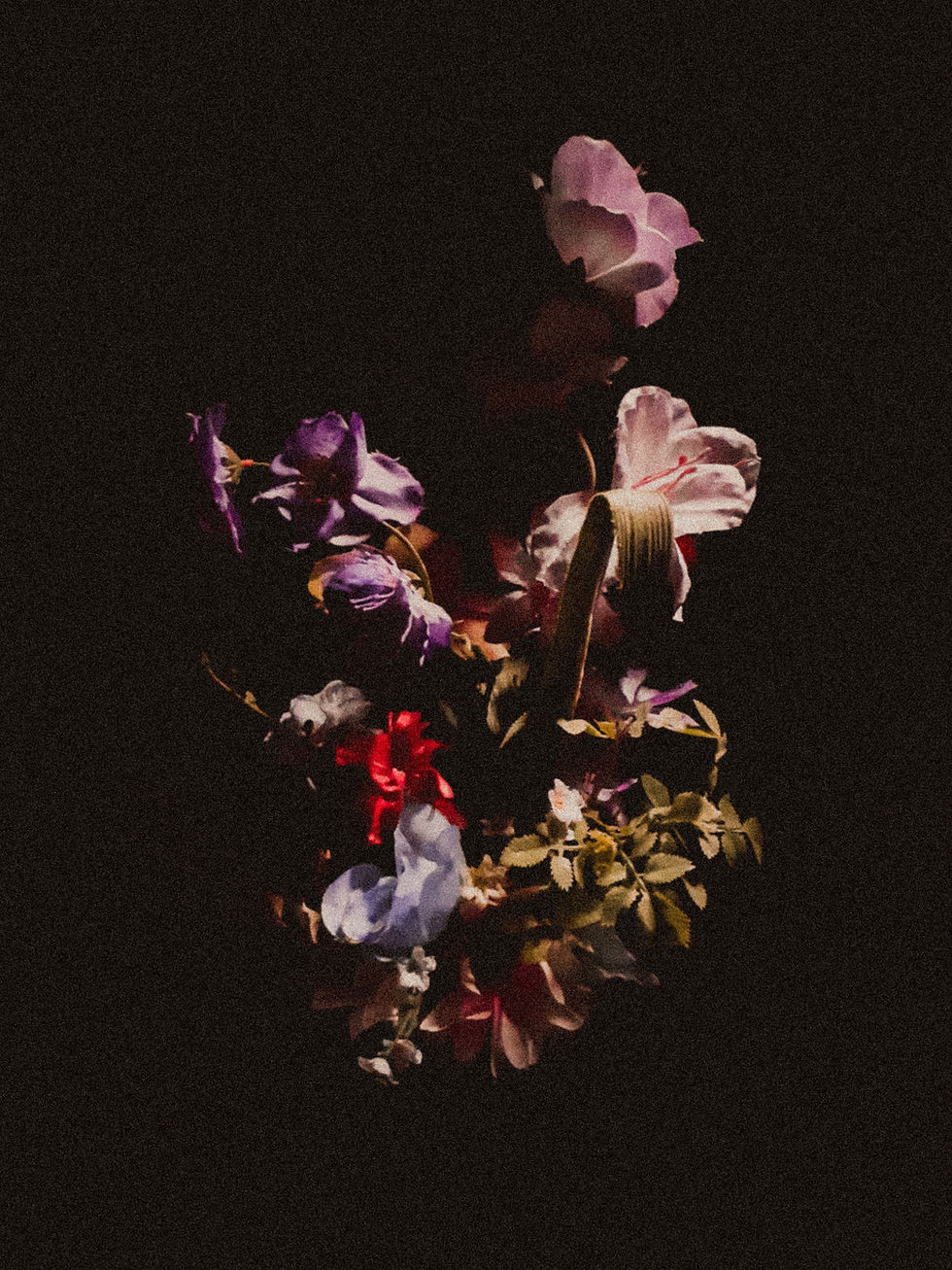
Here are only a few of her ten-thousand faces. Grief is a beauty, dressed in steel and lace, oleander bedecking her hair. Her cheeks are full, her arms are strong and supple, her legs corded but soft; she is a master of disguise. Grief wears many faces, for she is the many faced god. We westerners get Grief all wrong. We think that she answers to us; in our delusion we think all our gods do. Like her equally misunderstood sister, Love, we are particularly bold in our attempts to control or contain her.
As if she answers to our mandates.
To combat our audacity, Grief will visit us at times she knows we do not look for her: sitting on a park bench as an elderly couple walks by, in the mall when Frank Sinatra croons a Christmas carol over the loudspeaker, at a child’s birthday party. She comes on feet as soft as thieves, sneaks in between the cracks in the wall you build around your heart to keep her out. She is strong, and if you do not build her an altar she will consume your petty throne. She cannot be bought off or bargained with, only veneration and sacrifice
Of time,
Of attention
Of tears,
Of energy expelled
Can stay her hand.
My grandfather had a quiet and snowy 90th birthday a few days ago. I bought him a gold plated Casio watch, not dissimilar to the one in silver that he has worn all of my life. My mom sent me a video of him opening it, and my heart was made heavy by the frailty of him. He is not the man I remember from my youth. I’ve realized how much I am like him. How much his presence shaped me during those pivotal years. He gives and gives, silently, as is his way. He shows his love through service: gentlemanly, kind, easily taken for granted. Only, the gifts he gives are not granted at all.
One day, he will die.
Maybe, that day is sooner than I think. I did not process his lines and wrinkles when I kissed them before I left for Florida. Through a camera lens, though, they are all I can see. His shaking hands and hesitation with what to do with a gift he can actually appreciate, for its simplicity and the way it says, “I see you.” I do see him; everyday, when I look in the mirror, my grandfather is staring back at me. Someday, hopefully not too soon, that will be the only time I see his living, breathing face.
Love is Grief’s younger twin sister, separated in their entry to the world by a fraction of an eternity. I say this because it is not until we feel something’s absence, the loss of something dear, that we gain the insight to appreciate it as we should have while it was near to us. As the old adage goes, “you don’t know what you’ve got until it's gone.” Still, so few of us are taught to recognize their faces, it’s no wonder we are so often oblivious to their presence in our homes, our hearts.
In my estimation, Love has the plainer face, less striking. She is as strong as her sister, but her work is done quietly, her actions most impactful when most mundane. Her sister cares for darkness and places to stand unnoticed before she strikes. Love moves through the kitchens, gardens, attics of our lives, dusting surfaces and making beds and creating nourishment for our daily hunger, quenching our everyday thirst. This is why her absence is felt so powerfully. Grief is always near her, hovering just out of sight, and we like her this way. Perhaps, if I were honest, she is sitting in a chair for all to see. Perhaps, she waits to serve the bread her sister bakes, to pour the glass of freshly squeezed lemonade her sister made to fill it. I don’t know how to say that Grief loves her sister, Love. I don’t know how to say that Love loves her back. Speaking of gods is a messy business, and that is, perhaps, why we avoid it. Of course, we don’t avoid it on the surface. There are so many scrolls, books, and tomes on Grief and Love, yet so few that express their true nature. When I say few, I mean in the measurements with which we speak of galaxies, mushroom colonies, or ocean depths. Leagues and light years make all things made by man seem so small. To try and summarize powers so beyond time and space, so beyond our fathoming, is chasing after wind.
I love to chase the wind,
And she runs behind and before me, daring me to catch her. We are all chasing after something, and all of it is vanity. We control so little, not least of which is our very breath. If we were more intimate with the movement of our lungs, and our inability to determine how long they will move for us, Grief would not be such a stranger. I do not fantasize about tragedy, because it will come. Tragedy itself is just my interpretation of an everyday occurrence, the opulent lens through which I view the most normative occasions. Death, pain and suffering, loss, all these things we grieve, are as regularly occurring as the rising of the sun, as cyclical as the waxing and waning of the moon. Grief and Love would teach us this, but we are playful and our planet is young.
There is so much we must learn.
I am one of a few female clients in my rehabilitation center, and all of us are tending to our own tragic scenes, shouldering our own griefs. One of us must, everyday, choose her health over her presence with her children. Another, faces sacrificing the business she birthed for the sake of her sanity. One, now a dear friend, sits with grief - of loss, of death, of displacement - in hushed tones of conversation. Then I sit with who I once was and who I am becoming, picking through so many pieces to find the ones that fit the cracked places in my shell. There are more men than women here. Bright Hope casts a golden glow through their transparent hearts as they attend to the fractured segments of their lives.
Every day, we rise and attend groups where we untangle knotted yarns, stories and lies we’ve been told our whole lives. We learn to reconstruct whole worlds around a center that is ourself, after spending our whole lives being told that we must live at our own existence’s outer reaches, be a harbor wall for all the waves of people, places, and things we are meant to hold, containing them in their places. Even the gift of this new knowledge of our worth comes at a cost. To build a kingdom we must raise whole villages, burning past versions of ourselves for the sake of the ones being brought to bear. We find the purification process feels a wicked work. We cannot see ourselves deserving, worthy of the new life we are carving for ourselves. Grief and Love sit with us; they are more corporeal here in ways that, though different for us all, are unexpected.
We are the people with whom the gods sit; we are the ones that they guard at the third watch of the night.
If you enjoy what you are reading, you can subscribe to my blog by clicking the button below:
I never touched a cigarette before coming to rehabilitation. Now I smoke, and drink a cup of coffee and think of my grandmother. Think of the softness of her hair, the silver with smatterings of black, the waviness of it. I think of the softness of the blanket draped over her, and the gum that she chewed, peppermint flavored “Extra”, which she could store in her jowl for days, hoping that no one would see. I think of my uncle, the way he bit grapefruit with vigor, letting the juice dribble down his fingers. I think of him as he was in his right mind, and the guilt and shame I feel because I wasn't there when his mind left him. I think of the versions of myself that I've buried in the cool, soft earth for the last six years. The versions of myself that were born, zombie like, in my sickness, aching in my healing. I think of little losses, the faces Grief has taken in my life. I am learning something from her, though I am not sure what. And just as she wounds me, she binds me; just as she tears me asunder, so she stitches my wounds. My memories are hazy and tangible, my sorrow is flecked with joy. These gods make a temple out of me, an altar of my heart. I let them, as the cool morning air reddens my nose and the blood draws back from my fingertips.
Grief and Love are not the only gods.
There is Fear, spindly with wide six-fingered hands, the better to grip your throat, your ribcage, your intestines, and twist, twist, twist. There is Victory and Shame, Siamese twins attached at the central vertebrae, faces identical, but one assembled upside down so that it sees you in a way no one else can. Then there is Joy, whose smile is so wide she has no need to laugh, but stunning enough to make a wise man turn his face away. She takes only two lovers, Contentment and Wisdom, and neither fights for her as they give themselves to her completely. Then there is blessed little Hope, the body of a boy, scrappy muscles and always looking to wrestle, undeterred by the size of his opponent. There are too many to name, these gods we do not acknowledge near well enough. We lump them together because we do not see them for the power that they contain in their own right. They don’t contest because they know the one God, of which they are all a manifested part, is greater than them all.
I will name them another day.
My thirty-sixth birthday is fast approaching. With a ninety-year-old grandfather and a great-grandmother who died at the ripe age of one-hundred three, I figure my life is only ⅓ the way done. There are many versions of me that have been born, and have died, along the way. I write this from the front patio of a place that is safe, with post-rainshower sunshine bathing the bricks in palest yellow gold. I consider myself among the lucky ones, or perhaps the fateful meeting of atoms that has become me was always purposed for this.
There are many who have stories who will never tell them. There are many who would tell them, if only they had the chance. I sit at the juxtaposition of chance and desire, the opportunity to share what burns me from the inside out with words that feel insufficient, yet suffice. Today, I make myself an altar of Grief and Love, prepared to burn on both ends for something so far greater than myself that I have nothing to which I can compare it. In my sacrifice I have found eyes which see anew the glory of living, the wild wonder of being alive. For a moment, however briefly, I see clearly through the smoke. The wind carries away my burdens, and I am free.


Comments